
A simple, low-stress way to start decluttering your home — without giving up your pet’s comfort or your own sanity.
You open a closet, a drawer, or just look around the living room — and it’s suddenly too much. Where do you even start? If decluttering feels overwhelming before you’ve moved a single item, you’re not lacking discipline. You’re missing a starting point small enough to actually begin.
INTRODUCTION
Decluttering advice often assumes you have a free weekend, an empty house, and unlimited energy. Real life — especially life with a pet — rarely works that way. Between feeding schedules, walks, and everyday chaos, “declutter the whole house” can feel impossible before you even start.
The good news: decluttering doesn’t need to happen all at once, and it doesn’t need to be perfect. This guide breaks the process into small, manageable steps designed for real pet-owning households — so you can build momentum without the overwhelm.
TABLE OF CONTENTS
1.Why Decluttering Feels So Overwhelming
2.Start With One Surface, Not One Room
3.The 3-Box Method (Keep, Donate, Toss)
4.Decluttering Pet Items Without the Guilt
5.Building a 10-Minute Daily Reset Habit
7.FAQ
Why Decluttering Feels So Overwhelming
Most decluttering attempts fail not because of laziness, but because the starting point is too big. “Clean the whole house” isn’t a task — it’s dozens of tasks disguised as one. Your brain sees the size of the mountain, not the first step, and stalls before you even begin.
The fix is simple: shrink the task until it feels almost too easy to skip. A single drawer. A single shelf. One basket of toys. Small wins build the momentum that big goals can’t.
Start With One Surface, Not One Room
Pick a kitchen counter, a coffee table, or one shelf — not a whole room
Rooms feel infinite. Surfaces have edges. Starting with one visible surface gives you a finish line you can actually reach in under 15 minutes, and a visible result that motivates the next step.
3 quick wins:
- Choose a surface you see every day — the payoff feels more real when you notice it daily
- Set a timer for 10–15 minutes so the task has a clear end point
- Resist the urge to “just do one more area” once the timer ends — stopping on a win matters more than finishing everything
The 3-Box Method (Keep, Donate, Toss)
One simple system for every category of item
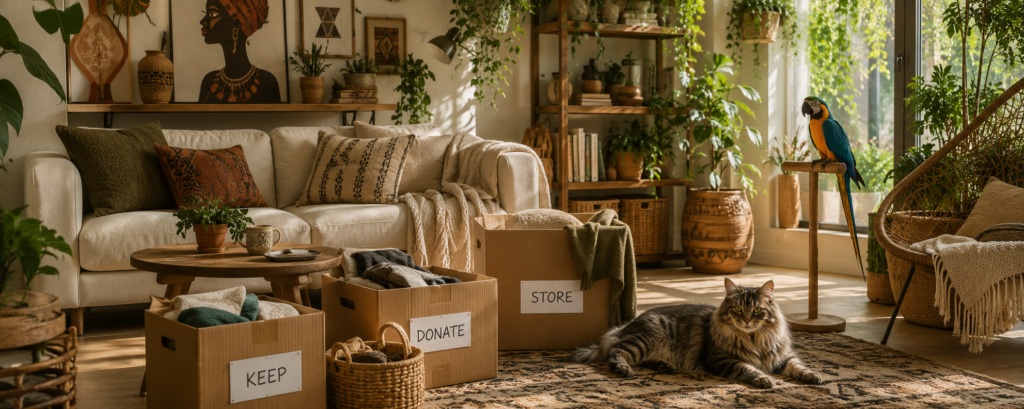
Label three boxes or bags: Keep, Donate, Toss. As you go through a space, every item gets sorted into one of the three — no maybes, no “I’ll decide later” pile, which is where most decluttering attempts quietly die.
3 quick wins:
- If you hesitate more than 10 seconds on an item, default to Donate rather than Keep
- Deliver the Donate box within 48 hours — items left sitting in the car or entryway tend to migrate back inside
- Do a separate, gentler pass for sentimental items rather than mixing them into the general sort
Decluttering Pet Items Without the Guilt
Not every toy needs to stay — and that’s okay
Pet items carry emotional weight — a first toy, a gift from a friend, gear you spent money on. But keeping every item “just in case” is often what leads to overflowing bins and forgotten corners. A little intentionality goes a long way.
3 quick wins:
- Keep items your pet actually uses regularly — check what’s untouched after a month, not what “might” get used
- Donate gently used pet gear to local shelters or rescues instead of keeping it in storage indefinitely
- If letting go feels hard, take a quick photo before donating — memory kept, space freed
Building a 10-Minute Daily Reset Habit
Maintenance matters more than one big cleanup
A single big declutter session gives you a tidy house for a week. A daily reset habit keeps it that way. The goal isn’t perfection — it’s a short, repeatable routine that prevents clutter from rebuilding.
3 quick wins:
- Pick one consistent time — right before bed or right after your pet’s evening walk works well for most routines
- Focus only on “putting things back,” not deep cleaning — that’s a separate task
- Involve the whole household (or make it part of your pet’s routine, like tidying toys after playtime) so it isn’t one person’s job
HelloOhNest Insight
🌿 HelloOhNest Insight Decluttering with a pet in the house isn’t about creating a magazine-perfect space — it’s about creating a home that’s easy to reset. The goal is a house that bounces back to “calm” quickly after a busy day, not one that stays untouched. Progress over perfection applies here more than almost anywhere else.
FAQ
Q: Where should I start if I genuinely don’t know where to begin? A: Start with the surface that bothers you the most every single day — often a kitchen counter or entryway table. Quick, visible wins in high-traffic spots build motivation faster than tackling a hidden closet first.
Q: My pet gets anxious when their things are moved. How do I declutter without disrupting them? A: Declutter gradually rather than all at once, and keep their core items — bed, main toys, food area — in the same familiar spot. Removing true extras (duplicate toys, unused gear) rarely causes stress, since the essentials stay consistent.
Q: How do I stop the “maybe” pile from taking over? A: Set a hard rule: if it’s been unused for more than a set period (30–60 days is a common guideline), it moves to Donate or Toss. Avoid creating a fourth “maybe” box altogether — it usually becomes permanent storage for clutter.
Q: Is it okay to donate or toss gifts I received for my pet? A: Yes. The value of a gift was in the moment it was given, not in keeping the item forever. If it’s unused and taking up space, letting it go doesn’t diminish the gesture behind it.
Q: How long does it actually take to declutter a whole home this way? A: It varies, but most households see a noticeable difference within 2–3 weeks of consistent 10–15 minute sessions. The goal isn’t speed — it’s building a system that keeps working long after the initial declutter is done.
Ready for the next step? Explore more guides in our Home Organization series from HelloOhNest.